WV2: Beyond the zero / Poza Zerem workshop, Torun, Poland, 27/8 march
Table of Contents
Documentation
Please see: wv2final
Workshop call
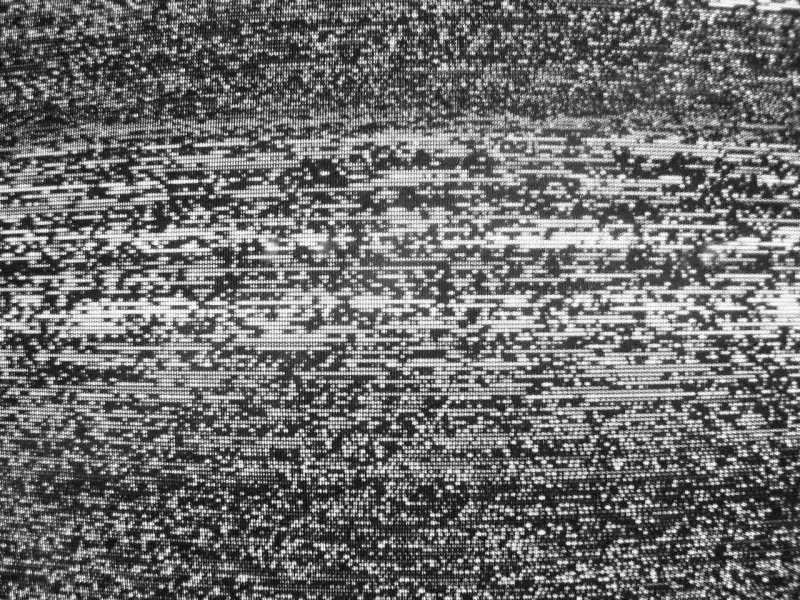
In the framework of the exhibition "Wach sind nur die Geister…" at Centrum Sztuki Współczesnej Znaki Czasu in Torun, Poland, registration is invited for the following workshop:
WV2: Beyond the Zero / Poza zerem
Workshop by Martin Howse (GB) in English
27th + 28th March 2010 (Sat + Sun 11am to 6/7 PM)
Please register until 23th March 2010 with pokojzkuchnia@gmail.com
How can one hide before that which never sets?
[Heraclitus. Frag. 16]
As a sequel to The White Visitation, conducted last year at the HMKV in Dortmund, WV2: Beyond the Zero / Poza zerem projects a further series of practical investigations within the realms of haunted media and psychogeophysics with particular attention to phenomena of light and revealing.
WV2 actively traces an interface line between contemporary technology and a certain Breakthrough, the very shattering of a notion of the real which is both haunted and provoked by modern physics and the history of communication media (telegraph, radio). The popular disciplines of EVP (Electronic Voice Phenomena)/ EIP (Electronic Image Phenomena)/ITC (Instrumental Transcommunication), established by figures such as Konstantin Raudive, and Friedrich Jurgenson, articulate this fault line, providing for a clear examination of the relations of environment, modulation (signal, transmission), detection, measurement and interpretation within frameworks which reject notions of causality.
Projected activities include the establishment of an overnight psychogeophysical measurement laboratory, repurposing of common media apparatus (tape recorder, television, video recorder) as scrying medium, psychogeophysical walk/fieldtrip, time axis manipulation and studies in light as a revealing.
Applicants should be motivated with an active interest in the research field. Please apply with a short sentence describing your interest by email to pokojzkuchnia@gmail.com
WV2: Beyond the Zero / Poza zerem [warsztaty prowadzone przez Martina Howse’a]
Centrum Sztuki Współczesnej Znaki Czasu w Toruniu w ramach wystawy "Nie śpią tylko duchy…" ogłasza nabór na warsztaty:
Workshop call in Polish
Warsztaty Martina Howse’a (Wielka Brytania)
- warsztaty prowadzone w języku angielskim -
27 + 28 marca 2010 (sobota + niedziela)
Centrum Sztuki Współczesnej Znaki Czasu w Toruniu
Zapisy do 23 marca 2010
Jak ukryć się przed tym, co nigdy nie zachodzi?
[Heraklit. Fragment 16]
Warsztaty WV2: Beyond the Zero / Poza zerem to kontynuacja The White Visitation [Białej wizytacji], warsztatów, które odbyły się w zeszłym roku w HMKV w Dortmundzie. Jest to kolejna seria badań w zakresie mediów nawiedzonych oraz psychogeofizyki ze szczególnym naciskiem na zjawisko światła i objawienia.
WV2 aktywnie śledzi związki między współczesną technologią a pewnym Przełomem, który wstrząsnął rozumieniem rzeczywistości, znajdującej się pod wpływem i tworzonej przez współczesną fizykę i historię mediów służących komunikacji (telegraf, radio). Popularne dyscypliny EVP (Electronic Voice Phenomena - elektroniczne zjawiska głosowe) / EIP (Electronic Image Phenomena – elektroniczne zjawiska wizualne) / ITC (Instrumental Transcommunication – transkomunikacja instrumentalna), zainicjowane przez takie osobistości jak Konstantin Raudive i Friedrich Jürgenson, definiują linię podziału i dostarczają metody badania relacji zachodzących w środowisku, modulacji (sygnału, transmisji), wykrywania, pomiarów oraz interpretacji, wykluczając przy tym pojęcie przyczynowości.
W ramach projektu powstanie nocne laboratorium pomiarów psychogeofizycznych. Popularne urządzenia (magnetofon, telewizor, nagrywarka wideo) zostaną wykorzystane jako media służące transkomunikacji. Odbędzie się też wycieczka psychogeofizyczna / badania terenowe. Prowadzone będą manipulacje osią czasu oraz badania światła jako objawienia.
Chętni do wzięcia udziału w warsztatach powinni wykazywać żywe zainteresowanie tematem badań. Zgłoszenia zawierające krótki opis swoich zainteresowań prosimy przesyłać na adres pokojzkuchnia@gmail.com
http://pokojzkuchnia.blogspot.com/2010/03/wv2-beyond-zero-poza-zerem.html
Research notes
17/03/2010:
- TSL257 photodetector

- straight into Arduino with supply (middle pin) as 3.3v gives best results.
- fixed for mini-skry platform using main.c.photoamp with TSL257 on ADC3 - pin 6 of mini-skry
- FGM-3 fluxgate magnetometer
- on mini-skry using main.c.fgm3x on pin 6 (note also FGM needs 4.5v and rest of circuit 3.3v)
- we just print counter which is related to frequency as calculation uses too much program space
18/03/2010:
- Hard Drive

- HD coil wired up to op27 op-amp circuit (10k feedback resistor), + with 10K to + and -. logging into minicom through ADC0 Arduino
- see looper for gnuplot script to reread live data (a=0, load looper)
-
also using octave to convert to audio semi-succesfully
xx=load("hdvoice");saveaudio("testt",xx,"mu",16) (16 bit mu-law)then load as raw data (16 bit PCM) into audacity (then normalize!)
- links
http://objectmix.com/graphics/139711-loop-gnuplot.html
http://www.unix.com/shell-programming-scripting/96187-gnuplot-shell-script-controlled-animation.html
http://www.obihiro.ac.jp/~suzukim/masuda/octave/html3/octave\_173.html
- questions
how to squash different gnuplots to same size/scale????
F: set multiplot
set style line 1 linecolor rgb "green"
plot "whitenoise06022010.log" w lines ls 1
- EVP/diode recordings
- using UHER (red wire is signal in, to record to laptop volume high and rec levels lowest)
Overview: http://vtf.de/technik.shtml
A survey and classification of EVP/ITC techniques:
1] Inter-frequenz method (Raudive) - tuning to a point between broadcast stations.
2] Microphone recordings (including use of audio frequency white noise)
3] Diode recordings

4] Autotransmission (Raudive): signal generator connected directly to aerial socket of a radio
4] Other methods (ultrasound, light).
5] Use of technical apparatus such as psychophon
- notes
- Radio frequency for EVP
Jurgenson frequency range: medium wave (MW) 1480 KHz (1,48 MHz)
Hans Otto Koenig frequency range: short wave (SW 31 m band 10 MHz and SW 41 m band 7 MHz)
Marcello Bacci frequency: SW 7 to 9 Megahertz,
Raymond Cass frequency: 127 MHz (air band frequency).
- run staticx.py with old webcam!
19/03/2010:
- video feedback
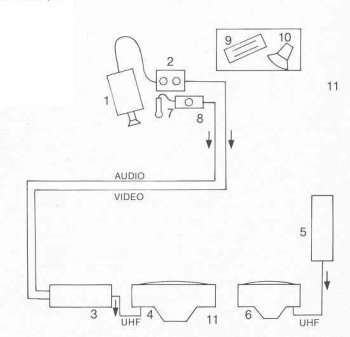
[diagram after klaus schreiber]
see also:
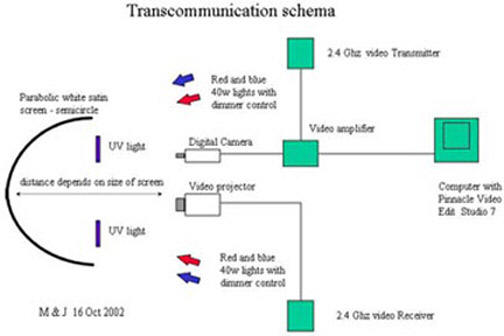
Channel 36. Camera into AV3 (composite socket at front). Record onto VHS tape.
- freezeframe video
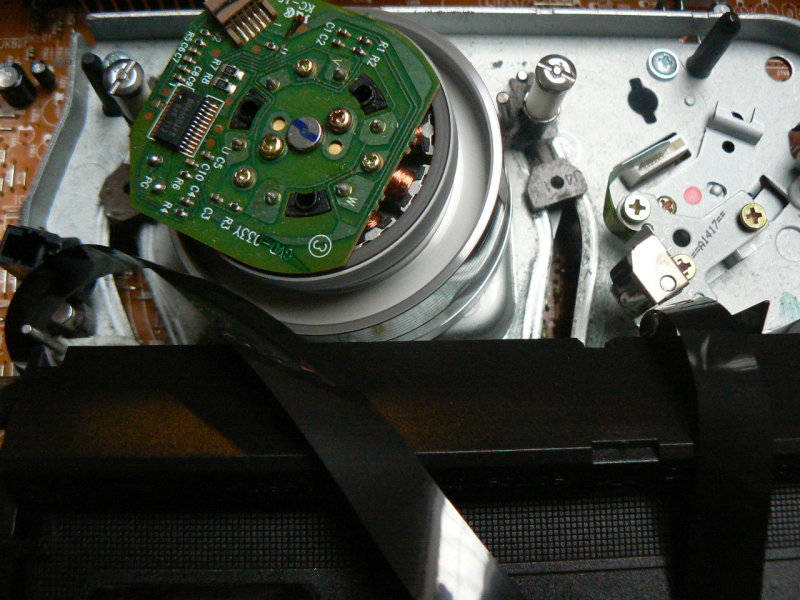
open video top and tape pulled to one side. responds to changes in local magnetic field.
20/03/2010:
- rough analysis of static frames
- use recorder.py to record jpegs from CPIA webcam
- analysis as on HOWTO :
- image_an.m
filename=argv(); pkg load image; #disp(filename{1}); xx=imread(filename{1}); img = rgb2gray(xx); ibw = img; m=128; disp(numel(ibw (ibw < m )))- analyse.sh
#!/bin/bash

for file in `ls *.jpg`
do
octave -qf image_an.m $file
done
- working with floppy drive as magnet field sensor
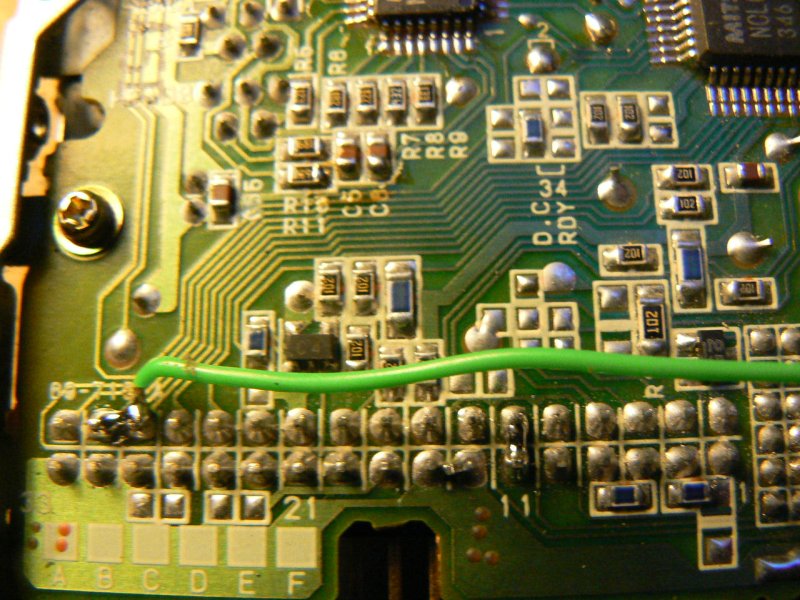
- connect pin 12 to GND to run motor
- signal seems stronger if comes from both pin 30 (data read) and 32 (select head) (?)
- playing floppy (also play with stepper (18 and/or 20 to GND) + feedback (sans floppy) through speaker
- recordings
- links:
http://answers.google.com/answers/threadview/id/247887.html
http://www.tvdsb.on.ca/banting/ICE3M/unit6/floppy/floppy\_cable\_pins.html
23/03/2010 photomultiplier research:
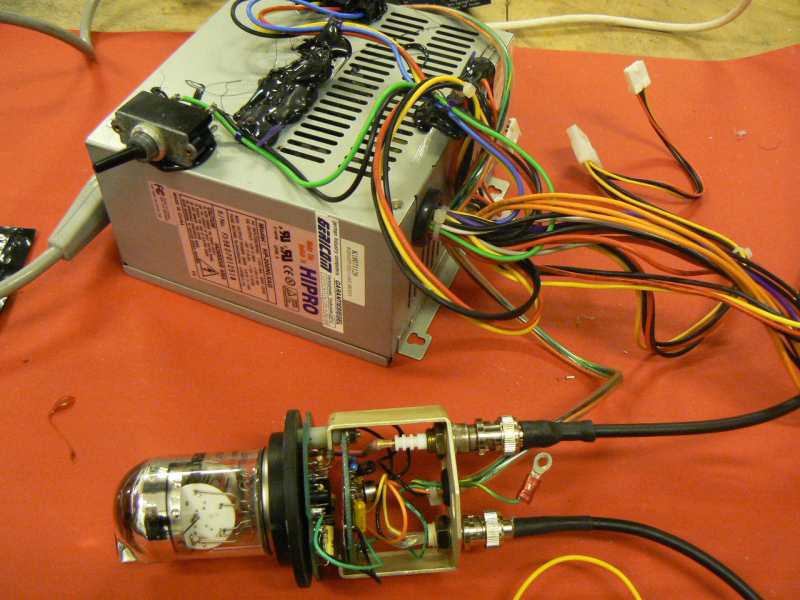
- notes:
- Burle 4526 (see datasheet: http://www.burle.com/cgi/byteserver.pl/pdf/4526a.pdf )
- question of polarity (kathode - centre pin should be at -1000v)
- connector is SHV (Safe High Voltage): ordered connector from Farnell:
http://de.farnell.com/kings/1705-2/plug-shv/dp/1608578
(connector is BNC on supply side: Brandenburg 2475R PSU)
- connections for pre-amp board attached (using LF256) +- 12/15v:
black: GND, green: -V (blue), orange +V (yellow on repurposed PSU)
- tested
with -1000V to Cathode and responds quite obviously to light (0.5v to 10v swing).
Schedule (2 days)
SATURDAY
- introductions and overview of techniques
- retroactive PK (psychokinesis) experiment
- discussion and elaboration of classical EVP techniques (psychophon, ultrasound), recordings and interpretation
- start experiments with photo-detection
- planning of field trip/walk
- set up of an evening measurement lab
SUNDAY
- interpretation of measurement lab results
- field trip
- photo-detection
- repurposing/work with video and imaging (staticx.py)
- future projects
Date: 2011-02-21 21:54:47 GMT
HTML generated by org-mode 6.31trans in emacs 23